
Salatul Hajat Dua: Life has a way of presenting us with moments where we feel stuck. Sometimes, the door feels closed, the problem feels too big, or the desire of our heart seems just out of reach. In those moments, Islam gives us a beautiful gift—a special way to turn to Allah, not just with a plea, but with a powerful prayer known as Salatul Hajat, the Prayer of Need.
Think of it as your personal, direct line to the Creator. It’s not just about asking; it’s about building a connection, showing humility, and acknowledging that all solutions lie with Him. Let’s break down this beautiful act of worship in a simple, human way.
What is Salatul Hajat? (A Simple Explanation)
Literally, “Hajat” means need or desire. So, Salatul Hajat is the prayer we perform when we have a specific need—whether it’s finding a job, healing from an illness, seeking guidance in a tough choice, or even mending a relationship.
The beauty of this prayer is that it follows the example of the Prophet Muhammad (peace be upon him). When a matter distressed him or when he needed something, he would turn to prayer. It’s a way of saying, “O Allah, I’ve done my part, and now I leave the rest to You.”
How to Perform Salatul Hajat: A Step-by-Step Guide
Don’t worry, it’s not complicated. It’s just you and Allah, having a sincere conversation.
- Start with Purity (Wudu): Just like any other prayer, begin by making a fresh and good Wudu. Clean yourself physically to prepare for a spiritual moment.
- Pray Two Rakahs: Perform two units (rakahs) of Nafl (voluntary) prayer. You can recite any Surah you know after Surah Al-Fatihah. Some scholars suggest reciting Ayat-ul-Kursi and Surah Al-Ikhlas for extra blessings, but it’s not mandatory.
- Praise and Salawat: After you finish the prayer and say your Salaam, don’t jump straight into asking. First, truly praise Allah. Thank Him for everything. Then, send blessings upon the Prophet Muhammad (peace be on him) —this is called Salawat or Durood.
- Make the Dua (Supplication): Now, raise your hands. This is your moment. You can make any sincere Dua in your own words and your own language. Ask Allah for your need from the bottom of your heart. However, it is highly recommended to recite the specific Dua that the Prophet (peace be upon him) taught us, which we have detailed below.
The Salatul Hajat Dua: Arabic, Urdu, Hindi & English
This is the heart of the prayer. Here is the special Dua in multiple languages so you can understand every beautiful word you are saying to Allah.
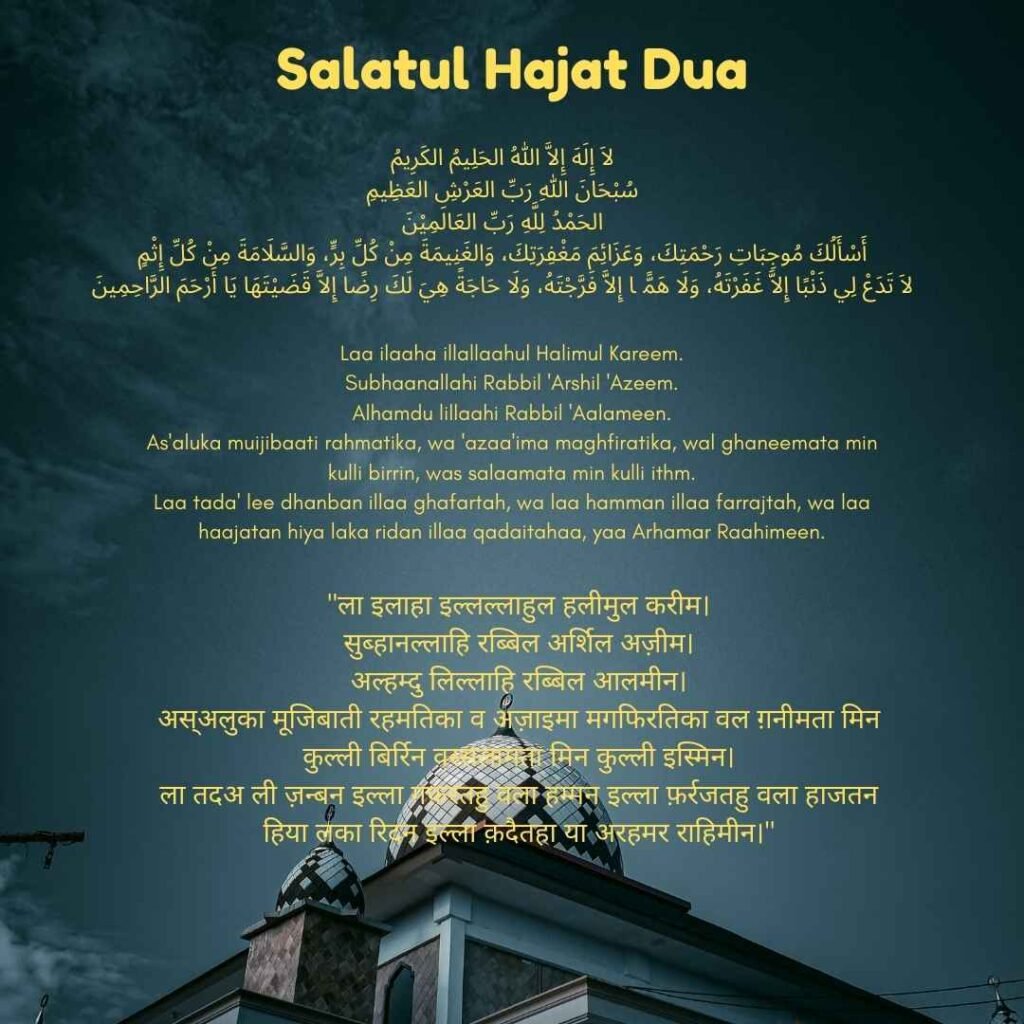
The Dua in Arabic
This is the original, preserved text of the Dua.
لاَ إِلَهَ إِلاَّ اللهُ الحَلِيمُ الكَرِيمُ
سُبْحَانَ اللهِ رَبِّ العَرْشِ العَظِيمِ
الحَمْدُ لِلَّهِ رَبِّ العَالَمِيْنَ
أَسْأَلُكَ مُوجِبَاتِ رَحْمَتِكَ، وَعَزَائِمَ مَغْفِرَتِكَ، وَالغَنِيمَةَ مِنْ كُلِّ بِرٍّ، وَالسَّلَامَةَ مِنْ كُلِّ إِثْمٍ
لاَ تَدَعْ لِي ذَنْبًا إِلاَّ غَفَرْتَهُ، وَلَا هَمًّا إِلاَّ فَرَّجْتَهُ، وَلَا حَاجَةً هِيَ لَكَ رِضًا إِلاَّ قَضَيْتَهَا يَا أَرْحَمَ الرَّاحِمِينَ
English Transliteration
For those who can read the English script, here is how to pronounce it.
Laa ilaaha illallaahul Halimul Kareem.
Subhaanallahi Rabbil ‘Arshil ‘Azeem.
Alhamdu lillaahi Rabbil ‘Aalameen.
As’aluka muijibaati rahmatika, wa ‘azaa’ima maghfiratika, wal ghaneemata min kulli birrin, was salaamata min kulli ithm.
Laa tada’ lee dhanban illaa ghafartah, wa laa hamman illaa farrajtah, wa laa haajatan hiya laka ridan illaa qadaitahaa, yaa Arhamar Raahimeen.
The Dua in Hindi/Urdu (For Easy Understanding)
यहाँ पर हिंदी में दुआ दी गई है ताकि आप समझ सकें कि आप क्या माँग रहे हैं.
“ला इलाहा इल्लल्लाहुल हलीमुल करीम।
सुब्हानल्लाहि रब्बिल अर्शिल अज़ीम।
अल्हम्दु लिल्लाहि रब्बिल आलमीन।
अस्अलुका मूजिबाती रहमतिका व अज़ाइमा मगफिरतिका वल ग़नीमता मिन कुल्ली बिर्रिन वस्सलामता मिन कुल्ली इस्मिन।
ला तदअ ली ज़न्बन इल्ला गफ़रतहु वला हम्मन इल्ला फ़र्रजतहु वला हाजतन हिया लका रिदन इल्ला क़दैतहा या अरहमर राहिमीन।”
The Meaning in English (Translation)
This is what you are actually saying to Allah.
“There is none worthy of worship but Allah, the Forbearing, the Generous.
Glory be to Allah, the Lord of the Mighty Throne.
All praise is due to Allah, the Lord of the worlds.
O Allah, I ask You for the means of Your mercy, and the determination for Your forgiveness, and the gain (enjoyment) of every good deed, and safety from every sin.
Do not leave any sin of mine unforgiven, nor any worry of mine unrelieved, nor any need that is pleasing to You unfulfilled, O Most Merciful of the merciful!”
Unlocking the Blessings: The Benefits of Salatul Hajat
Why go through this effort? Because the benefits are immense. It’s more than just a transaction; it’s a transformation.
- A Direct Line to the King: The greatest benefit is that you are presenting your case directly to Allah. You are bypassing all worldly means and taking your need to the One who controls everything.
- Cleansing the Heart: The Dua itself is a cure. By asking for forgiveness for every sin and relief from every worry, you are lightening your spiritual load. It’s a detox for the soul.
- The “Spoils” of Good Deeds: The Dua asks for al-ghanimah (the spoils) of every good deed. Think of it as asking Allah to let you truly enjoy and benefit from the good you do, making your worship feel fresh and meaningful.
- Learning to Trust: Sometimes, we ask for things that aren’t good for us. The Dua beautifully asks for “every need that is pleasing to You.” This teaches us to trust Allah’s plan. If your need isn’t fulfilled, know that it wasn’t pleasing for you at that time, and Allah has something better in store.
- A Source of Peace: Just the act of praying, pouring your heart out, and knowing that you have a Lord who listens—ya Arhamar Raahimeen (O Most Merciful of the merciful)—brings an immense sense of peace and calm to a worried heart.
When and Where Can You Pray It?
There is no fixed time for Salatul Hajat. You can pray it whenever you feel the need, except for the times when prayer is forbidden (like sunrise, zenith, and sunset). However, the deep silence of the last third of the night is a particularly special time when Allah descends to the lowest heaven and asks, “Who is asking of Me, that I may give him?”.
So, the next time you feel that weight on your shoulders, perform your Wudu, face the Qibla, and pour your heart out to the One who truly cares. Your need is not too big or too small for Him.
Also Read: 4 Powerful Ramadan Dua for Fasting You Need to Know (Suhoor & Iftar)